Due to a hack of the institutional platform, articles prior to No. 28 (2018) are available at https://revistaestudav.usach.cl/. We will let you know when the complete collection is back on OJS.
No. 44 (2026)
The works published in this issue of EstuDAv Estudios Avanzados reflect the richness and diversity of Latin American and interdisciplinary critical thought. The volume opens with a contribution from Graciela Carrasco López, who examines José Vasconcelos's intellectual engagement with Mexico between 1907 and 1920, recovering the links that connect thought, action, and cultural project in our America. Maintaining a critical perspective, Juan Carlos Rosillo-Villena prompts reflection on egalitarian governance and the indicators of democratic quality under Chavismo between 2007 and 2013, analyzing the institutional performativity of this political process.
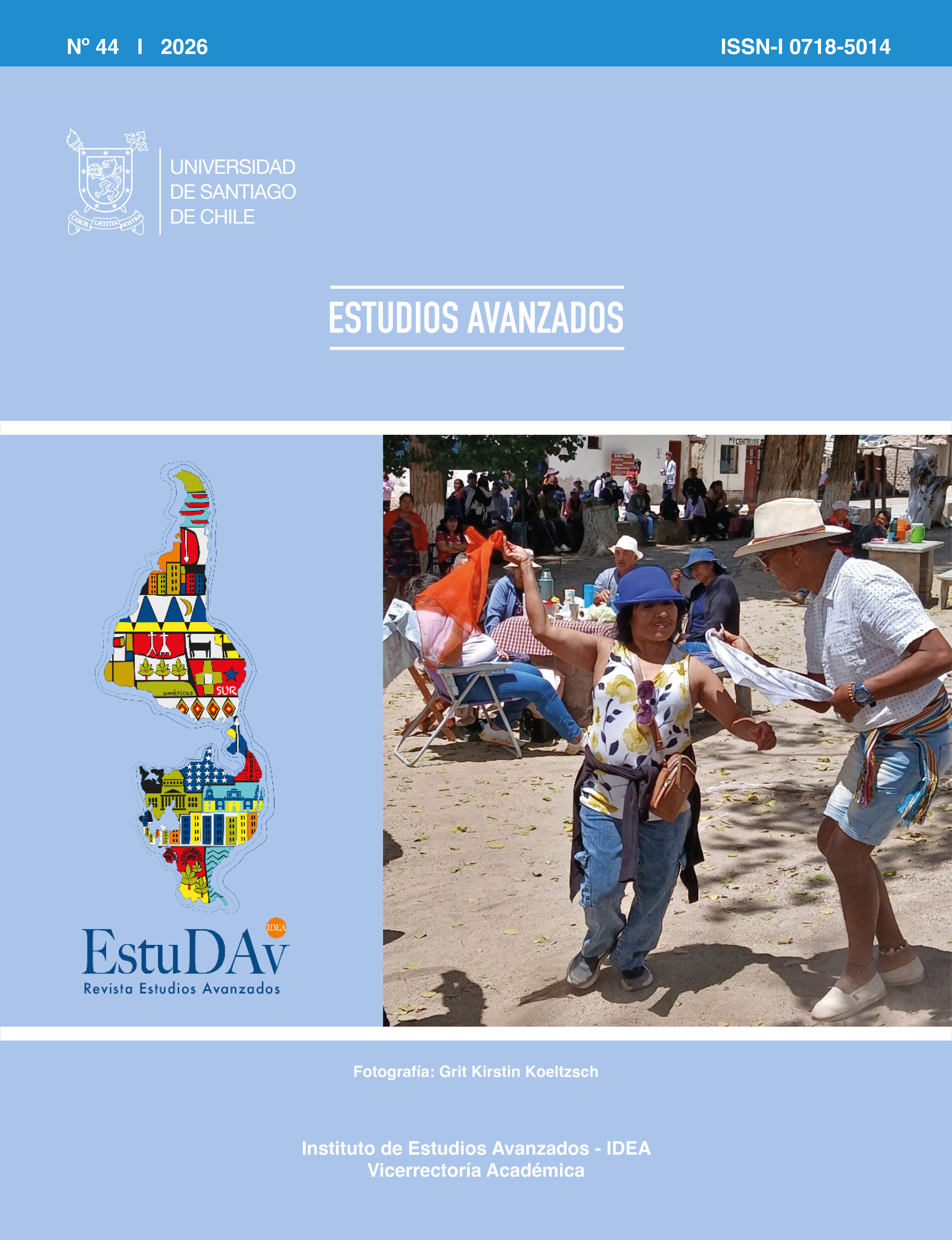
Reflexivity serves as a bridge to broaden understandings of health inequality in the work of Laurencia Lucila Silveti and Horacio Antonio Pereyra, who address this phenomenon from Santiago del Estero, Argentina, during the period 2007–2024. From a visual perspective of performativity, Grit Kirstin Koeltzsch offers a methodological contribution to examining intercorporeality in Andean dance festivities, proposing the concept of the microscope of time as an analytical tool. This visual perspective continues with the work of María José Delpiano Kaempffer, who explores the transgressions generated by the donkey motif in the satirical press of Chile and Peru during the 19th century, revealing tensions between visual norms and their subversions.
Atilio Raúl Rubino offers a theoretical contribution to queer literature, proposing, from the desert to the swamp, the foundations of a literary theory that challenges hegemonic categories of criticism. Paula Tesche, Asef Antonio, and Bruno Jara Ahumada develop an analysis of Miguel Littin's work from the perspective of clandestinity, reconstructing the landscapes and atmospheres that permeate the trajectory of this Chilean filmmaker. Peripheral realism, addressed through the lens of sovereignty and autonomy as a counterpoint to central theories, is explored by Silvia T. Álvarez and Aldana Clemente, contributing a Southern perspective to the debates within international relations theory.
With the aim of promoting a new global order and inaugurating the interview section, Dominique González interviews Eduardo Devés Valdés, who discusses the potential of vivocracy as an alternative for a decolonizing relationship with nature.
Finally, Paula Aguilar presents female corpographies based on her review of Fabiana Carneiro da Silva's book, Casa Cheia. We hope you enjoy reading these contemporary and interdisciplinary contributions from Latin America.
Published:
2026-06-23